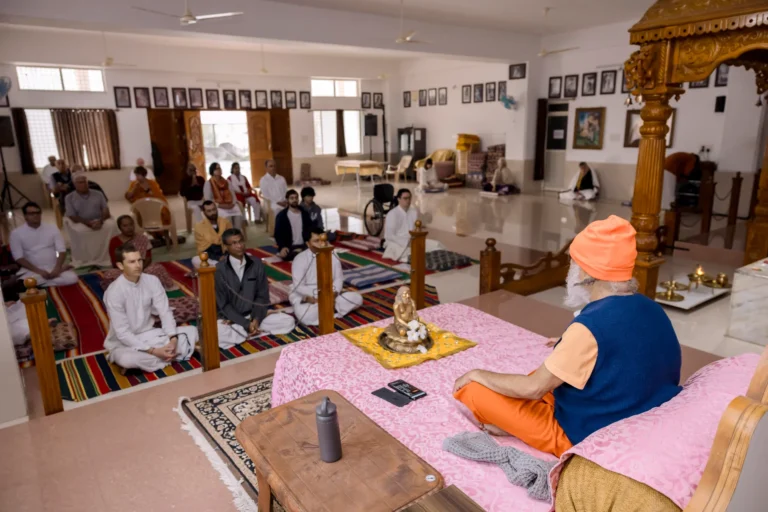

Recorded on 23 February 2025 with US participants
0:00 Intro
0:08 Chapter 6 “The Higher Knowledge”, verses 1-4 “I am all beings, and all beings are in Me.”
7:50 That “I” is not the body or the ideas in the mind. What is the distinction between thoughts and imaginations in the mind, the mind and pure consciousness?
11:59 So Baba, the mind is synonymous with the consciousness of existence, of our being conscious of existing?
12:29 So that’s the purpose of meditation. Meditation is to quiet the mind, shift our awareness from being on the thoughts and imaginations that are in the mind.
12:56 So Baba, that has to happen automatically, spontaneously, the turning to its Self, because at that point you can’t be thinking.
13:29 So you can’t really be thinking and be in that state. Is that correct?
14:09 In meditation people can have experiences, you’re really not in the Self at that time. You’re just caught up in a higher, better imagination?
15:17 So the yogi has to have the resolve to silence the mind and not get carried away with the imaginations as they can be more profound and more charming, and more alluring.
16:03 What’s the distinction between the Consciousness of Existence and the Self, or the mind and the Self?
16:58 “Very often, seekers give up worldly life and go to the forest caves and ashrams, and they just end up struggling for another world that they have in their imagination.”
19:15 Supreme Peace is beyond bliss.
20:05 “There is nothing to give up if you don’t hold on to anything in the mind.”
22:16 “Once you’ve acquired the awareness-knowledge, there is nothing that you have to absorb, and nothing is there that you have to give up.”
24:35 What does Babaji mean by ‘awareness-knowledge’?
25:30 So that awareness-knowledge is when you’ve managed to quiet the mind of all the extraneous thoughts, but you still have that awareness of your own existence?
26:10 So it’s that last state, where all thoughts have been withdrawn, except it’s conscious of its own existence, and then that merges into the Self.
29:00 The meaning of the terms tyaga and tapas.
32:39 How is body consciousness different from there mind?
34:37 How is karma related to the practice of quietening the mind? In the practice of meditation, how can karmas help you?
36:24 How do the karmas of everyday living also impact progressing in our spirituality?
“The Higher Knowledge” – Ashtavakra Gita, Chapter 6 | In Quest of Truth – Babaji Q&A, No. 240
YouTube link: https://youtu.be/VV7W2EU9Tvs
Recorded on 23 February 2025 with US participants
Questioner: Okay, Baba, thank you. Chapter Six.
King Janaka, after He has attained Self-Realization, is expounding the truth to his Guru, Ashtavakra. Baba, I’ll read the Verse, and if You want to comment, just interrupt or I’ll ask questions too as we go along.
Shri Babaji: Okay.
Questioner: Okay, thank you, Chapter Six, ‘The Higher Knowledge’. Janaka speaks:
1. “I am Boundless as Space, and this universe is bounded like a jar. Know This – then there is neither renunciation, nor attainment, nor dissolution.”
2. “I am like the ocean, and the universe is like the waves. Know This – then there is neither anything to be given up, nor anything to be absorbed, nor any settling back.”
3. “I am the seashell, and the universe is that illusion of a shiny mother-of-pearl. Know This – then there is neither relinquishing, nor grasping, or dissolving.”
4. “I am all beings, and all beings are in Me. Knowing This, there is no renunciation, nor attainment, nor dissolution”.
Shri Babaji: These sentences are usually found in scriptures, several other scriptures also when about the Self the master teaches, or gives [clues], that one realizes. Just like you realize you are the mind, and you are not the thought or a vision that is in the mind. Then you realize all thoughts and all visions, whatever we consider as matter, or universe, a separate world, is in the mind, and the mind is infinite, just like space. Actually, I would repeat, in my opinion, the space itself. Because if I tell space itself, if there is a separate definition, criteria sitting in the mind, then it would become a bit difficult to believe. Because the all-pervaded Ultimate Truth needs to be the Supreme Consciousness of Existence, whereas space appears to be simply a void place. But in my opinion, today, I would like to clarify and stand by the sentence; “Space is not simply a void place.” Space is ‘space’ because we have imagined it as ‘space’; somebody told us, and we have taken it in good faith and believed “It is a void place.”
Like if we all remember, the first time when we heard the definition for space in the school, the teacher said “The void place in between these two walls is known as space”. So, thus the space is sitting in our minds as a void place, but actually it is the absoluteness. When we get to see, it is the space which is holding the entire universe. So, when a yogi realizes this as the Self, that Self is infinite and all pervaded – space is not actually space but it is the Self which is all-pervaded – this has to be individually experienced when you do sadhana. That is how Janaka also experienced it by the teachings of his Guru, Ashtavakra. In the same way when we did tapas, we experienced this, that ‘the entire universe is within me’.
When I call that ‘within me’, it is not the narrow shaped body or a narrow personality or the name of Shiva Rudra Balayogi. All ideas will get dropped. It is simply an all-pervadedness. That’s what one needs to understand when He says, “I am beyond all these things, and in me, I am holding the entire universe”. Also, in Kathopanishad, one beautiful sentence comes. Yama, while teaching to Nachiketa, says, “When the Divine wanted to create, there was no other raw material other than divinity. It was all-pervaded everywhere. Only divinity as a single Self existed. No second entity was there. So, then the Divine took out from itself to create, using the imagination technology, creativity.” So that’s how the universe is also nothing but the form of the Divinity, because it is within the Divinity. Just like the thoughts and visions that are in your mind cannot go out of your mind. Mind itself you cannot show to anybody – yesterday also we were discussing the same point – mind itself also you cannot show, “This is my mind”, right?
Questioner: Excuse me for interrupting. You froze there for about ten or fifteen seconds and we missed what you were saying.
Shri Babaji: The internet bandwidth has become low, so that’s why my voice would have been missed.
Yeah. In Kathopanishad Yama tells, when the Divine wanted to create, using the technology of imagination, creativity – that means just you have to imagine, then the world appears. Just like when you imagine in your mind a thought appears. Means for the creation, it is only imagination, that is why we also tell that this entire creation or universe has appearance value, but not existence value. Or at least if you try to observe that this world is impermanent, which will go away, it can disappear any moment, anything can happen, like that. That is what is the Ultimate Truth. These are the things which Janaka goes on telling. That’s what we need to understand. But you will experience it only when you reach the higher consciousness of deeper samadhi state, then this will come into experience. Otherwise, sometimes by reading scriptures, it can be confusing also.
Questioner: Okay Baba, I’ll read some of Your comments in the text. They’ll reiterate some of the things You’ve just said.
“After obtaining Self-Realization, the seeker Janaka says, “The universe arising from me is not real, and the Self alone is real. ‘I’ as the Self am all-pervasive.” Sri Krishna was not meaning the Krishna who stood in that body and gave this highest knowledge; that ‘I’ was the Supreme Consciousness that is all-pervasive. Though one talks of the universe as unreal, at the moment of learning one is not to concern themselves until Self-Realization is achieved.”
So here, Baba, You’re saying that the ‘I’ is not the body and it’s not even the ideas that are arising in the mind. Can you talk a little bit about the distinction between thoughts and imaginations that are in the mind, the mind, and pure consciousness?
Shri Babaji: If you keenly observe, thoughts and visions are inside the mind, in the mind, they cannot go out of mind. As I told, you cannot show the mind itself also, and you cannot show, “Hey look, this thought is in the mind or out of this mind. It cannot go. Otherwise, if you could have taken out the thought from the mind, you could… [connection is lost].
Questioner: Yeah, I think we’ve lost Baba momentarily.
Shri Babaji: Yes, yes, I can hear you now. Okay, let me try.
Questioner: You were starting to address the distinction between thoughts, mind and consciousness.
Shri Babaji: When you are fast imagining, fast means continuously; day after day, day after day in your life, you would forget that you are imagining the things that are in your mind. Instead, your mind considers whatever is in the mind as a reality. It won’t even notice where the mind is, what the mind is, whether the mind is imagining or where the things are in the mind. But suddenly you realize you are that mind, because that is where the ‘I’ consciousness of existence is coming from. That means you are that mind. The thoughts and visions are within you. That is how you realize. And you also realize that this thoughts and visions-world is there because of my imagination. So, all I have to do is withdraw my imagination. I have to become quiet, in other words, then the universe disappears, then there is peace.
So, this is Ashtavakra’s teachings. Janaka also says, “This world is within me. This universe is within me, and I am unaffected by this world, because I am the all-pervading absoluteness.” So, that is the Ultimate Truth; that’s how you realize in a samadhi state called Nirvikalpa samadhi when you practice and achieve that one. Then you remain unmoved. This is what Janaka is trying to tell. The clue is the mind itself. If you understand the mind, you will be able to understand the Ultimate Truth also, easily.
Questioner: So, Baba, the mind is synonymous with the consciousness of existence, of us being conscious of existing?
Shri Babaji: Exactly. We are calling it mind because of thoughts that are in the mind. Otherwise, that is the Consciousness of Existence. If you keenly observe, if your attention goes on to that, giving up its attention to all thoughts and visions, then you will know this.
Questioner: So, that’s the purpose of meditation. Meditation is to quiet the mind, shift our awareness from being on the thoughts and imaginations that are in the mind.
Shri Babaji: First, we advocate just watching so that you achieve the silence of the mind, quietness of the mind. Then its attention turns to itself. Then it realizes “I am This.”
Questioner: So Baba, that has to happen automatically, spontaneously, the turning to its Self, because at that point you can’t be thinking?
Shri Babaji: No, thinking will never give you that truth. You will simply end up imagining with some other thoughts. The thinking can go wild also. You will never be able to think exactly about that Truth. Simply you have to become quiet and individually experience.
Questioner: So Baba, you can’t really be thinking and be in that state. Is that correct?
Shri Babaji: Yes, exactly. You cannot be. If you think, you come out of that. But at least you should be able to go back and settle in the Self, in that awareness, even if you think. But if you get carried away, you will continue thinking and forget to settle into the Self. That’s what has happened to the jeevatmas, the individual souls.
Questioner: In meditation people can have experiences, expanded consciousness, other beings, other worlds, blissfulness, all those things, and then the attention goes to that. Those are actually in the field of thought, in the field of imagination. And so, if the attention goes to that, that keeps you from… you’re really not in the Self at that time. You’re just caught up in a higher, better imagination.
Shri Babaji: You are simply getting carried away. Because the imagination becomes manifested or mental projection when the concentration of the mind increases, but it continues with imagination. So, these experiences happen. That you have to realize; “This was only my own projection, my own imagination which has resulted in this manifestation.” Then that disappears, and you are back into meditation. So, that’s what happens. During tapas also, you experience this as a practical workshop.
Questioner: So, the yogi has to have that resolve to silence the mind and not get carried away with the imaginations, because as the consciousness develops the imaginations develop too. They can be more profound and more charming, and more alluring.
Shri Babaji: Yes, people get attracted. Many people misunderstand an experience means it has to be a vision, a thought, a world, something like that, then they say, “Oh, I had some beautiful experience.” A beautiful experience is dumbfound, silence; that happens only when you just watch.
Questioner: So Baba, what’s the distinction? If mind is the Consciousness of Existence, essentially the consciousness of our existing, what’s the distinction between the Consciousness of Existence and the Self, or the mind and the Self?
Shri Babaji: Just before final merger, just for sake of understanding, so that you can narrow down your observation, your watching, to that we try to tell, ‘Consciousness of Existence.’ Then as you watch, then this ‘Consciousness of Existence’ thought also disappears and you simply merge.
Questioner: You just become existence?
Shri Babaji: Existence. That also you don’t think. You exist, but you don’t think that you exist.
Questioner: I will read through some of the points in Your commentary on chapter six, just because they’re profound. I read “The universe arising from me is not real and the Self alone is real. ‘I’, as the Self, am all-pervasive.” “Very often, seekers give up worldly life and go to the forest, caves and ashrams, and they just end up struggling for another world that they have in their imagination. Even though they seem to have given up this world and renounced it, actually, they end up not renouncing anything. They hold on with their ego and desires and greed. It is the mind which has to renounce all of its imaginations. That is what is repeated, as there is nothing to give up or absorb, just become aware of the Truth, which is the real knowledge.”
Shri Babaji: People often get carried away and expect that traveling to different worlds, or long traveling, experiences of such visions as a great experience, as a great achievement in meditation, whereas I would like to tell it is all getting carried away only. These experiences will not take you to the Ultimate Truth of the Self. It will not give you any knowledge, any wisdom, any awareness of the Self; nothing comes. So that is why you need to finally reject them or overcome them and realize that these have no existence value. This is important. That’s why if one can understand right from the beginning when these types of experiences come, they have no existence value, just another hypnotizing effect has happened from which you need to come out, that you are trying to become one with the Self – that is most important. That must not be given up.
Questioner: Baba, the experience of some of those states, it’s very blissful, so it is very charming. But as You pointed out in the past, Supreme Peace is beyond bliss. That bliss ultimately, when the bliss settles down, when the mind completely settles down, that bliss turns into Supreme Peace, complete contentment.
Shri Babaji: Yeah, my idea of telling this is because bliss can create excitement and make a consciousness get carried away with the imagination, projection and manifestations, which are not real actually.
Questioner: Okay, I’m going to read.
“This comes through the sadhana of giving up all imaginations. When the mind merges with the Self, then it is realized that the universe has arisen from the Self and subsides into the Self. When Self-Realization happens, it appears nothing ever happened at all. You don’t have to run to forests and caves for Self-Realization, meditate where you are. There is nothing to give up if you do not hold on to anything in the mind.”
Baba, can you explain, “There is nothing to give up if you don’t hold on to anything in the mind”? You’ve said that several times here.
Shri Babaji: What I mean by this sentence, “nothing to give up,” means nothing of this way of life. Simply by trying to give up externally, nothing goes away actually, because the mind would be carrying. You have to give up in the mind. Like Swamiji said, if you go to caves and forests, you will be carrying your mind also. There also the mind will trouble you. If you have a way of life in the world, you will start remembering that and you will start missing them. People come to ashrams. They can stay for a certain time period only, after that their minds will be drawn back to the world. They will start missing their homes, their dear ones, their kith and kin—unless you are made for going to Self only, so that you don’t miss for anything. Instead of this, one can meditate wherever one is; whatever way of life you have adopted, just be in that. You don’t have to give up anything. Just meditate, so that the mind gives up; that is enough. Externally, you just behave in the natural way of life that you have adopted. You don’t have to give up anything.
Questioner: It says in your commentary, “That’s how Janaka says in every stanza, once you’ve acquired the awareness- knowledge, there is nothing that you have to absorb, and nothing is there that you have to give up. You have to become quiet, that is all. There is no thought or vision that you have to get rid of. There’s nothing that you have to tackle. You just have to become quiet in the mind.”
Shri Babaji: A Guru, every teacher who is Self-Realized or connected to Self-Realization, always tells about samadhi, Nirvikalpa samadhi. Why this word has been used? That means once for all a total silence of the consciousness must happen—naturally, effortlessly, so that it remains quiet. That is when the Nirvikalpa samadhi happens, not until then. Traveling to different worlds cannot happen in Nirvikalpa samadhi. If you are traveling in your meditation or tapas to different worlds, that means a Nirvikalpa samadhi has not yet happened. Still, you are into manifestations, that is what it means. So, you give up that idea of manifestations. Don’t get carried away, that means, don’t get attracted too much. At the most, use it to remain focused without making any judgments. This is very important.
Then, if all of them disappear, then your mind can go more introverted, then it becomes Pure Consciousness, going towards samadhi. ‘Nirvikalpa samadhi’ word also has been used by many teachers, because that is when every idea gets dropped, every vision, every thought, every imagination, every creation, everything disappears. One single Self exists in itself, and that is not equivalent to any of the worldly experiences at all. It is much beyond. There is no relative existence that you can narrate such an experience.
Questioner: Okay, Baba, there’s a term You use. You’ve used it several times before, and I’d like You to elaborate on that—”awareness-knowledge”. You say, once you’ve acquired the awareness-knowledge. Is that Consciousness of Existence?
Shri Babaji: Yeah, you simply merge with the Consciousness of Existence. You are simply aware of the existence. This also has to disappear when you go for actual Nirvikalpa samadhi. That means you continue remaining quiet. That’s what continuing tapas means. When you continue tapas, means you continue remaining quiet.
Questioner: So that awareness-knowledge, Baba, is when you’ve managed to quiet the mind of all the extraneous thoughts, but you still have that awareness?
Shri Babaji: Simply an existence. Awareness is there, but no thought or definitions are there for that. You feel as if you are existing, but you don’t define what it is. That is when you tend to tell, “I am this” or “I am that”, either way, anything. No further definitions. You think whatever it is, it’s all the same.
Questioner: Yeah, so it’s that last state, where all thoughts have been withdrawn, except it’s conscious of its own existence, and then that merges into the Self.
Shri Babaji: Yeah, you don’t identify with either of the duality. Means it is there and it is not there, and you don’t identify with either of them. It is neither atman nor anatman. Some spiritual seekers argue Buddha’s teachings “anatman, anatman, He didn’t talk of atman.” He simply spoke of anatman; that doesn’t mean that He didn’t recognize the atman. If you are recognizing it is not there, you are recognizing it is there. If you recognize a bad thing, you recognize a good thing. Only in comparison to the good thing are you calling this as a bad thing. If anybody asks you, “Why is this a bad thing?” See, “This is good, you have to be like this. If you are not like this, it is bad,” that comparison happens. If that is over, finished.
Questioner: Yes, all analysis, all judgment, comparison, all activities that happen in the mind, beyond.
Okay Baba, “When the mind becomes quiet and no more thoughts or visions are coming, in that stillness of consciousness what you are aware of is the Truth of Existence. It is supremely peaceful. You neither get attracted by this world, nor do you reject the world. You are neither happy or unhappy; you are at peace, contented, composed.”
Questioner: That ends Chapter Six, Baba. Do we have more time, or…
Shri Babaji: We have come to the height of these teachings, very wonderful. That is all one has to understand of Ashtavakra Samhita.
Questioner: AndBaba, Chapter Seven continues in this very, very high knowledge. It’s beautiful. So, we save that for next time?
Shri Babaji: Yes, next session we will take up chapter seven.
Questioner: Okay, so we’ll take a few questions from people.
Shri Babaji: If anybody has connected to spirituality, not out of spirituality, about this spiritual truth, only please raise your hand. A couple of questions we will take. Don’t come with out of context questions, please.
Questioner: Namaste Babaji.
Shri Babaji: Yes, yes, please.
Questioner:I’ve been thinking about tyaga (sacrifice) and tapas (to burn). What I’m thinking is that tapas is a really general term, tyaga is also a very general term. So, tapas is tyaga?
Shri Babaji: If you talk of tyaga, what is it that you have to sacrifice, that comes. You have to give up everything. To give up everything you do tapas. ‘Tapas’ word is used here so that you burn out all habits of the mind. In ancient times tapas was used particularly for this, but afterwards people might use it for so many other things. If a person is living a hard life of sacrifice, “Oh, he is doing a tapas,” but not this tapas. This tapas is only to quieten the mind and merge with the Self. Burn out all habits of the mind; that is this tapas. It is only for this purpose the tapas is used.
Questioner: Tapas has to be defined. It has to be defined. What tapas.
Shri Babaji: Yeah, if the question comes, then elaborately we can define. About tyaga also, like Bhagavad Gita talks, ‘Tyaga Shanti Anantaram’. So many people get confused. What is it that we have to sacrifice? Then a Guru, if Self Realized, has to explain, here the tyaga means giving up all thoughts and visions of the mind. When you sacrifice it in the mind, you have peace in the mind.
Questioner: People don’t even want to use the word tyaga. It’s almost removed from the dictionary, you know.
Shri Babaji: Yes, exactly, so they don’t want to use this. So many other terminologies have been used to entertain devotees, so it is all lost and gets confused. Whereas in ancient times this has been very much used for these purposes. Like Adi Shankara’s ‘Jnana, bhakti, vairagya.’ Vairagya is you give up in the mind the idea of the existence of the world. That is Vairagya.
Questioner: Okay. So that’s what I was thinking. You know, these days nobody wants to dwell on the word tyaga or renunciate. Renunciate they look at it as a bad connotation, that they are not interested in life.
Shri Babaji: People can twist and give any meaning to suit their convenience very often. So, that’s what happens. So, people have twisted and used and reused to their convenience. So, anything can happen now. The sanyas had a particular meaning when it was founded, when it advocated. But then as things go on, people use this ‘sanyas’ to their convenience.
Questioner: Babaji, I had questions, the one I posted on the chat, and another one. I’ll start with one from the chat. Babaji, how is body consciousness different from the mind, because Babaji talks about some stages in meditation. Is body consciousness, at the very start of this whole practice, different from the mind?
Shri Babaji: You see, body consciousness you get through the brain’s reflections. The mind watches the brain’s reflections and registers that in itself. Like for example, here you get to watch Babaji on the screen. Then your brain absorbs this and it reflects, then your mind catches and registers, then you feel the existence of Babaji sitting on the screen. So, these reactions happen like this. In the same way, body consciousness has come to this mind because of continuously watching the brain’s reflections and getting carried away by not verifying what the Truth is. Just like without verifying what the truth is on the screen that a movie is happening, you get carried away. The movie is you. You are the movie. Everything appears as if it is happening to you. So, in the same way, body consciousness has been obtained, and it is so strong. Even while alive, for a yogi, if somebody pinches or cuts, the pain will be there because the mind is watching—a little bit of consciousness is in touch with the brain. This completely goes only when the body drops.
Questioner: Thank you Babaji. One more question. Babaji, how is karma related to the practice of quietening the mind? In the practice of meditation, how can karmas help?
Shri Babaji: You see, if you had been trying in your previous life for spiritual truths, or now also in this life you go on trying for spiritual truths, your body becomes aged, and if you are unable to achieve Self-Realization for some reason and after aging, becoming old the body dies, the next life you will have the inclination. You will be born to such parents again, to such atmosphere, to such surroundings, that you will get a strong inclination to go towards spiritual truths. Such doubts occur to you; you will want to know what the truth is. That yearning comes. So, that is how the efforts of actions turn out to be the karma, that your mind absorbs as imprints and develops as an attitude. That is when the inclination also comes. That is how karma is connected to your spiritual things also. When you achieve samadhi, you would have stopped the future. A Yogi would have stopped the future, but whatever had been resolved in the previous life, that all comes as the body’s ailments or any such things happen. So, that is how the karma is connected.
Questioner: So Babaji, even when we are on the path spirituality, practising, much before attaining samadhi, much before that, the karmas which are habits of the mind picked up from previous, past or any efforts, during practice something also surfaces, like the imaginations will come on the top – one living in the world will experience a lot of efforts and actions to make towards the world. So, these karmas, how does everyday living also impact progressing in our spirituality?
Shri Babaji: Suppose, for example, you are on the spiritual path, but along with the spiritual path, worldly also, academically you might have achieved something distinctively. So thus, you are like a software engineer, so you automatically get exposure to this world and worldly achievements; they also get absorbed in the mind unknown to you. So then, spiritual and these worldly achievements, they go together parallelly. Thus a karma gets created. Then finally, balance—’kiska palla bhari hai’ (whichever one is increasing or has the greatest weight); that type of thing. Whichever has the weight increasing. If spiritual involvement in this life increases, then for need only you are a software engineer, just for the sake of earning a livelihood for a while. So, then your spirituality wins. Or, unknown to you, if you get carried away with your worldly achievements, that you are a software engineer, that you can use your computer brains, any such thing, then your spiritual achievements or spiritual tendencies get reduced and the worldly tendencies increase. So, you are on the edge like the snake and ladder. Either you go and go up the ladder or you can come down the snake, depending on the tendencies.
Now you have to be very careful so that your mind, unknown to you, must not get carried away by worldly achievements. Let it be. It’s a good thing, not a bad idea; you can earn your livelihood, but keep it there. Don’t allow it to raise its head too much. More spiritual thinking, that truth is necessary. That is how these karmas are connected, and can make you to go on this path or decline. Any such thing can happen. One has to be careful.
Okay, thank you so much and will say bye-bye to everyone.
End of Session