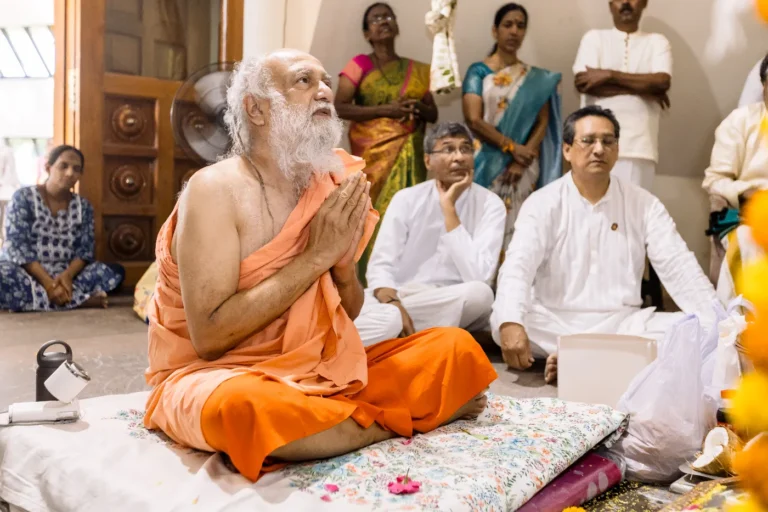
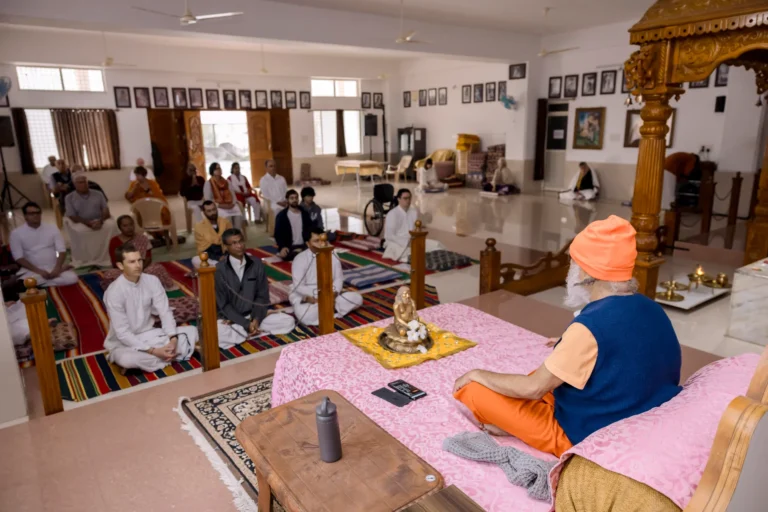
Recorded on 27 July 2025 with US participants
0:00 Intro
0:48 Chapter 14, verse 1
1:22 “The mind being fully settled in the Self” – what do you mean by the mind?
4:22 For a Self Realized person, do thoughts arise in the mind?
6:21 So thoughts arise as needed and then spontaneously settle down?
6:50 It seems that the nature of the mind is to have thoughts, but you’ve also said the nature of the mind is to be silent.
8:15 What makes creation start? What makes thoughts arise?
8:39 So could you say that creation in the mind is a second nature of the mind?
10:19 Once Self Realization has happened, will nothing make the mind go back to the world?
10:46 What is it about the unrealized person that keeps us involved in the Maya, unable to see the truth of our own Self?
11:30 The difference between an intention and desire is you want something to happen, but you have no attachment to it?
12:35 Babaji comments on the term in science, ‘singularity’
15:56 For the Self Realized person, what happens to karma? Is there still karma for the body?
18:08 What is it that makes consciousness become mind?
18:42 Chapter 14, verse 1 – the indifference of a Yogi to the world.
20:24 Chapter 14, verse 2 – What keeps a Self Realized person functioning, if there is no attachment to the world?
23:10 For the Self Realized person the wisdom comes spontaneously. It’s not book learning.
24:16 So the scriptures and knowledge are really unnecessary?
25:15 What books would Babji recommend people to read for inspiration, besides the Ashtavakra Gita?
26:04 Chapter 14, verse 3 – Is a Self-Realized person just a silent witness to everything that’s happening?
27:48 Chapter 14, verse 4 – the Self Realized person can be involved in thought, but never loses awareness that He’s infinite, eternal, unbounded?
29:42 “For the Self Realized one, the mind will be infinite like space.”
33:16 Seeing everything as divine, every atom.
33:58 “knowledge is self experience”
35:55 Consciousness has potential to express itself in some type of creation or imagination – when that’s there, you call it mind, when it’s not there you call it consciousness?
37:55 Science will never fully prove the Self because the only way to know the Self is to become the Self?
40:56 You can’t tell who’s an enlightened person by looking at them.
41:38 Babaji’s use of word peace instead of tranquility.
43:18 Are the imprints in the mind, the habits and patterns we have adopted? Do we also contain the habits of our parents and ancestors along with our own?
47:41 How to explain to others about the spiritual path.
49:38 Is our ability to understand from our karma?
50:17 In nirvikalpa samadhi Babaji observed matter disappearing – does that mean the universe doesn’t exist without an observer to observe it?
51:19 What is on the other side of a black hole?
52:48 What is the best way to select and cultivate a purpose in life?
54:08 The role of enjoyment in a Self Realized being.
57:15 Should one sit in one place to chant mantra japa?
58:01 How to get rid of negative imprints of somebody?
59:09 Are peace and silence the only worldly imaginations of the space?
1:00:13 How to know whether a thought is arising from intuition or the imagination.
1:01:10 Can unhappiness return for enlightened ones, and can an enlighten mind be free from states of body, like health, illness, pleasure, pain?
Tranquility – Ashtavakra Samhita, Ch.14 | In Quest of Truth – Babaji Q&A, No.246
YouTube Link: https://youtu.be/_bcu8y1n5vQ
Recorded on 27 July 2025 with US participants
Facilitator:
Thank you everybody for being with us today. We’re going to continue with the Ashtavakra Gita. It’s chapter 14, titled ‘Tranquillity’, and we’ll read through the verses and gather whatever comments we can from Baba. Okay, Baba, if it’s okay, I’ll read the verse, and then we can comment on it. So Janaka speaks. Janaka was the disciple of Ashtavakra who obtained Self-Realisation.
Verse one, chapter 14. “The mind being fully settled in the Self, That One no longer holds the effects of past actions in the mind, is no longer involved with or attracted to objects of the illusory universe. Thoughts arise for the sake of worldly activity, but don’t bind the mind. The One is awake, even though they might appear asleep.”
Question:
So, Baba, first thing, “The mind being fully settled in the Self.” Would you explain to us what you mean by mind?
Shri Babaji:
Yeah, I have tried to explain in a little different way, like maintaining a sattvic ego. And once you are able to do tapas and achieve total silence and the merger of the mind into the Self happens, mind gets absorbed into the Self. Well, I have told this doesn’t mean that you have lost the mind. The mind is there; its power is always available. You realise the mind is nothing but you yourself, actually. You were thinking, and now you have stopped thinking. So, all the time, mind is totally silent. Like I tell, even if I am gossiping or anybody else is trying to talk to me, my mind does not picturize or imagine and doesn’t go into anything.
However, if I need to teach, if I need to deal with some situation, I may use my mind, that which we call it as sattvic ego; that within a periphery, that attachment to the Guru, His Mission, like this type of thing. So, I use the nearest imagination, but I will not allow that mind to get carried away, further binding itself into the incidents of the world or doing its own imaginations. So, that’s what precisely this book also endorses, what I have been speaking many times in my talks like this.
Once you have achieved, the first thing that Ashtavakra talks is of an enlightened soul. For an enlightened soul, the mind is totally settled into the Self. It does not imagine anything, and it does not get binded into this world. No binding, because there is no ‘I’, no imagination, nothing is there, it is the totally Liberated one. However, if I need to talk or deal with a situation or need to teach, I have told that I have to use the nearest imagination. At that time, I might use some imagination effects of the mind so that I can deal. But most of the time, while answering a question, spontaneously it comes out of me, even without thinking also. This is what I have observed. I don’t have to think or plan or frame anything, and it simply comes out, such an answer. So, this is what has been tried to be explained in these verses.
Question:
So, Baba, normally we think of the mind as all our imaginations and ideas and thoughts, memories. It can be creative. But as you look into it, you realize you can have thoughts, but you’re not the thoughts. You’re the one watching the thoughts. So, for a Self-Realised person are thoughts coming? If you’re just sitting there watching us meditate, are there thoughts arising in the mind, but you’re just not involved in them, or are there no thoughts arising?
Shri Babaji:
No, always not arising. Thoughts don’t arise like that. Suppose you are all sitting into meditation. I just watch and nothing arises. Nothing strikes in my mind. Nothing registers, in other words, to be more precise; nothing comes to the mind, actually. But occasionally, if I need to use any imagination on my own… Like when you ask a question, even at that time I don’t have to use any imagination at all. Spontaneously the answer comes. But if I myself have to talk or deal with any such situation, then a little bit imagination might come up, I might use it. But I will restrain myself, it will go back; once the job is done it won’t get carried away further into the world. Whereas for an ordinary person, the mind gets carried away and it gets involved into further imaginations; thought after thought, thought after thought keep coming, imagination after imagination keep coming, making a person experience happiness, unhappiness, tension, fear, brooding about the past, anxious about the future. All these things happen to a person, but not for the enlightened soul.
Question:
So, as needed, as necessary to deal with the world thoughts can arise from consciousness, and then spontaneously settle back down.
Shri Babaji:
Yes. Means that consciousness and creative power is there. Anytime we can tap that energy and become creative or imagine and talk or deal with the situation.
Question:
So, Baba, it seems that it is the nature of the mind to think or to have thoughts, but You’ve also said that the nature of the mind is to be silent, to be just pure consciousness.
Shri Babaji:
Now, in my opinion, original nature of the mind is to remain silent in the Self. That is what is the Divinity we have recognized as, which is all pervaded. Its nature is to remain in total stillness, which is known as Mahasamadhi. It can imagine, it has the power, creative power. Just imagining itself is known as the sattvic quality of the consciousness, as Adi Shankara puts it. But if it further stubbornly believes whatever it imagines as the only truth, then that is a bit wrong. It goes into a king-like arrogance—”I am thinking like this, and this is the Truth”. That is what is the rajasic nature of the mind it goes into. But original nature is to remain silent, at peace, totally contented.
Question:
Then what makes creation start, Baba? What makes thought arise?
Shri Babaji:
If the consciousness starts imagining, within the consciousness, a creation happens. Like your mind starts imagining, and within your mind a creation happens, and that’s what would be sitting in a person’s mind as a separate world.
Question:
So that seems like another, a second nature of consciousness.
Shri Babaji:
It is available. Nature we usually would like to call—in its nature it is there and it naturally behaves like that. But here I would like to tell in its actual nature it would like to keep quiet, in its original nature. But if the energy wants to use it, then that is not the actual nature of it. It has to go back to remain in its nature. Hope I’m clear what I’m trying to convey. Its original nature is to remain quiet in itself.
So, it has the ability to be creative, that also, quickly it goes back to the Self, as the original nature of it is to keep quiet. Like, for example, if I think and imagine and try to say something, immediately after I have said, that will go back to itself and settle there, that is the original nature of it. So, I brought it upwards, because it has the ability, but it will not remain as a nature like that always, it will go back to itself, and that is the original nature.
Question:
You’ve said, Baba in the past, that once Self-Realization has happened, nothing will make the mind go back to the world.
Shri Babaji:
Yeah, it will not go back. It will remain in its nature. It will remain quiet. Even if you use it, like I’m telling, it will go back and settle. Just like the tyre, “Psssst”, settling back, like that.
Question:
So, what is it about the unrealised person that keeps us involved in the maya, unable to see the truth of our own Self, who’s watching.
Shri Babaji:
Unrealised person means he is an unskilled person. He gets involved into further imaginations. He thinks by imagining only he is able to find out, gain the knowledge. That curiosity, inquisitiveness increases and thus gets involved into further creating thought after thought, thought after thought, millions and millions of thoughts keep coming.
Question:
So, Baba, a Self-Realised person, I understand has no desire, although you seem to have intentions. It’s playing with words maybe, but the difference between an intention and desire is you want something to happen, but you have no attachment to it. Whereas desires, you want something to happen, but you’re kind of attached to the outcome too.
Shri Babaji:
Yeah, we are not attached to the outcome and not attached to what others would react. Whatever I have to do, I just do it and become quiet. So there is no desire to continue, there is no such thing. Simply, I intend to create an awareness about Self-Realisation, as wanted by my Guru, or, that which we also could achieve, we would like to help others to achieve. So, that is the intention, that is all.
Question:
Baba, there’s a term in science called ‘singularity’. Have you heard this word before?
Shri Babaji:
No. Singularity?
Question:
Singularity. I’m not a scientist, but as I understand it, or as I take it, it’s like a field of all possibilities. It’s what I associate with the consciousness of existence, where everything that could possibly be exists in a potential form. It hasn’t manifested. It hasn’t become actualized, but it exists potentially. From Pure Consciousness, which is just the Silent Witness, Parabrahman, the Absolute. Then you have consciousness of existence, which is more like mind or singularity or this field where it’s awake, it’s conscious that it exists, but without any thought or anything actually manifesting yet. And from there, creation starts to emanate; time, space, matter all emerge from the singularity, from the consciousness of existence. Does that word relate to any terms that you’re familiar with? Is there some similarity between consciousness of existence and this idea of singularity, where everything exists in an unmanifest potential form?
Shri Babaji:
So, we have to say, in all possibility, the Supreme Consciousness has the ability to create in all possibilities. Something like that, I have to say. So that is possible. Possibility is there. So, we cannot rule out anything. We cannot say it is not possible for that. Though it remains in itself in supreme peace, there is all possibility that it can create. But whenever it creates, a micro speck comes out of it. When it gets carried away, goes after thought after thought, goes on analysing and making judgments and judgments, it then gets involved into the vicious cycle of getting creative. But that creativity is affecting its peace, its stability to remain in itself.
Question:
Some attachment arises. I guess, as soon as we make any kind of judgment that something is this way rather than that way…
Shri Babaji:
Yeah. As soon as an attachment arises of what you imagine, then you bind yourself to that judgment.
Question:
And that sustains the maya, sustains the illusion.
Shri Babaji:
That is what is known as illusion. That is the power of illusion.
Question:
Okay, going on here, it says, “The mind being fully settled in the Self, no longer holds the effects of past actions in the mind, no longer involved or attracted to objects of the illusory universe. Thoughts arise for the sake of worldly activity, but they don’t bind the mind. That one is awake, even though they might appear asleep.”
So, Baba, for the Self-Realised person, what happens to karma? The mind has now become silent and merged with the Self, but as you were just saying, it can come out to do specific things as a person, but the body is still there. You still have the body. So, is there no more karma for the Self-Realised person, because the mind isn’t involved, yet there is karma for the body?
Shri Babaji:
Because the mind is not involving, a yogi would have stopped the future, but whatever the past lives, if anything was there, that will appear in the body as long as the body is alive. That will appear. It can appear as an illness, or somebody trying to trouble the person, somebody trying to crucify a yogi. So, these type of things might all occur. These are all prarabdhas. Prarabdhas do happen, but a Yogi will remain unattached to them because he has no judgments. He has stopped the future; no more karmas, no more absorption of any imprints will happen.
Question:
So, mentally he is liberated, but the body still has to go through its sufferings.
Shri Babaji:
Yeah. So, whatever, as long as it is there, it has to go through the nature of things.
Question:
So, what is it that makes consciousness become mind?
Shri Babaji:
When it starts imagining, it becomes mind, and when it gets attracted to its own imaginations, considering that imagination as a truth of existence, then it further gets involved, and it becomes a bundle of thoughts – that is what is known as mind. Thus, the pure consciousness gets transformed into a mind.
Question:
So, reading on here from Verse One chapter 14. “No longer involved or attracted to objects of the illusory universe.” I get that consciousness is not involved in the activity, but ‘[not] attracted to’ doesn’t necessarily mean that you’re not concerned. You can look at it like a state of indifference, but You’re anything but indifferent to the world, even though You may not be involved in it.
Shri Babaji:
Yeah, a Yogi would appear as if He is indifferent, but He is not actually indifferent. It may appear a bit negative for others, this word of ‘indifference’. Simply, a Yogi remains in Himself, in the Self, so He is unaware of anything. Just like when you are soundly sleeping, you are unaware of what is going on in the streets. So, you are not at fault, simply you are asleep. That’s why you did not know. Means, Yogi also, He is not negatively indifferent. If anybody prays to Him, He becomes compassionate also. He becomes compassionate, tries to help them. But on His own, no imagination occurs to Him, so that’s why He may not be able to notice anything of this world.
Question:
Verse two. “Desires having now melted away, where are riches, friends, interests in the illusions of the universe? What use are scriptures and knowledge?”
So, Self-Realised persons are desire-free or not attached to their desires. They can still have intentions. What keeps them functioning if there’s no attachment to anything in the world? What keeps You getting up every day or coming on these calls with us?
Shri Babaji:
Generally, I have spoken as a sattvic ego, an attachment to the Guru’s name or what the Guru wanted to convey, a message. If the Guru has ordained, “You do this mission work, you look after this mission,” something like that enables the brain to be alive, thus the body also to be alive and getting up. That is what is also recognised as a ‘prarabdha’. The prarabdha of this body is there. It is attached to the Guru’s name and the Guru’s institution or mission, whatever you want to call. So thus, it mechanically keeps working. It will eat and it will go around, it will try, but its activities will become more minimum, very minimum.
Nowadays, you see? As the days are passing, it’s becoming more difficult for me to travel, and some people have to push and have to tell, or some strong reason has to be there, then half-heartedly I go, I do, and come. Otherwise left alone, simply I don’t even go down to look into the streets or the gardens many times; I am just in my room, just sitting. So, this thing is what happens. Then somebody reminds, “You need to exercise, you need to walk a little bit,” so they push us, then I have to undertake some walking and go around—so thus it goes minimum, minimum. Again, I have to bring it up with great difficulty. It will be as difficult, or much more difficult than what you all struggle to bring the mind to quietness.
Question:
I remember You saying that, that’s amazing,
Okay, Baba, it says here, “What use of scriptures and knowledge?” You said earlier, for the Self-Realised person the wisdom that you are giving us just comes spontaneously. It’s not book learning. It’s not something you memorised. It just comes to your consciousness?
Shri Babaji:
Yeah, see, just like a lecturer or a professor or anybody who is teaching, they would have prepared themselves by reading books and all such things. I don’t read any books. I don’t prepare for this session. I don’t know what is going to come up as a question for me to comment. So, anything, a slight hint if you give, then spontaneously that comes out. If it comes as a question from you or as a suggestion to comment, that thing spontaneously comes out. Until a while ago, I didn’t know what I needed to talk or what I was going to talk. Nothing was there. I just sat here.
Question:
So thus, the scriptures and knowledge are really unnecessary.
Shri Babaji:
Once you achieve Self-Realisation, then the ladder’s job is done, you are on the terrace now. That is what it is, like that. But for other people, we would recommend, to motivate yourself, to feel inspired, you need to read some scriptures which are nearest to the Truth. That is what we always recommend. But for a Self-Realised Soul, there is no need of any other book. Sometimes people give me to read a book and read this, read that one, but there is nothing for me to read anything or gain any such knowledge anymore. The knowledge, the world also has disappeared. What knowledge is there? Just keeping quiet, that is all.
Question:
Baba, are there any books that you would recommend that people read for inspiration, besides the Ashtavakra Gita?
Shri Babaji:
Yoga Vasistha, Rishabha Gita, Vivekachoodamani of Adi Shankara, these type of books are very close to the Truth. Kathopanishad. These are very beautiful, very closer to the Truth, authentically. They talk so one can understand. When you read the Yoga Vasistha also, you can understand why you need to silence the mind, and then you gain the Truth. Yamaraja talks to Nachiketa also about the truth of the Atman in the Kathopanishad so beautifully.
Question:
Verse three. “The mind now settled in supreme, pure Self, a pure witness, I see neither bondage nor freedom, and have no concern to seek liberation.”
So, Baba, is this the experience of a Self-Realised person? They’re just a silent witness to everything that’s happening?
Shri Babaji:
Yeah, that’s how many times scriptures also talk, a yogi is only a witness. Means, as long as this body is there, whatever is connected to this body, those things are all visible, but mentally, no attachment comes at all. It’s a very vague dream type. It’s a very amazing thing, difficult to explain what it is. People should not misunderstand; I have to emphasise that I love you all. [Babaji laughs] Don’t worry.
Question:
Baba, I think many of us that have meditated, we’ve had some experiences of being the witness, and it’s supremely peaceful.
Shri Babaji:
Yeah, because mentally, if you don’t get involved, you are supremely peaceful.
Question:
Easier said than done, Baba.
Shri Babaji:
Yeah, we agree.
Question:
Okay, verse four. “With the mind completely settled and not dragged into thoughts, and the body is simply acting as required in the world, such a one can appear deluded or confused to others. They can only be understood by one who has also attained That.” [Self-Realisation].
You mentioned earlier that the state of being for a Self-Realised person is the mind doesn’t get dragged into thoughts. If something is needed to be done, the thought will arise and then as soon as it’s completed, no extra thoughts. As soon as it’s completed, it goes back to stillness.
But, I want to clarify, Baba, unlike us who get involved in something that we’re trying to do and forgetting about everything else, the Self-Realised person, as I understand it, can be involved in thought, but never loses awareness that He’s infinite, eternal, unbounded.
Shri Babaji:
It’s always there. Just like you might be gossiping with a friend on the smartphone, but you will not forget that you are Agastya. Like that, simply – that awareness is always there.
Question:
Then the body is simply acting as required. You addressed that also; as needed, thoughts and activities will come up.
Shri Babaji:
Exactly, exactly.
Question:
In [Babaji’s] comments, the very first sentence says, “For the Self-Realised one, the mind will be infinite like space.” Can you elaborate on that? I know that space exists within it. It’s really more than space, but space is the closest thing we can imagine.
Shri Babaji:
Yeah, you see, as long as thoughts and visions are there in the mind, the mind’s attention goes to those thoughts and visions only. It seldom goes to itself, that which is the infinite form, just like the space. I have told numerous times, the example of when you enter a room, your attention seldom goes to the space. It can go to the pillar, it can go to fan, it can go to people sitting there – all sorts of things its attention quickly goes, and recognises, analyses, judges, but never bothers about the space itself there. Its greatness also is never bothered. It is the space which is holding all the things, finally, Ultimate Truth.
‘Space’ – in that name we recognise, just for the sake of understanding or communication. That is the terminology that was told to us. That’s why it is. ‘Space’ need not be just a space that we are imagining. It can be something else. So thus, a yogi realises that as the Ultimate Truth. That which is, you see, everything tells; like ancient sages have told, “It is there and it is not there”. And I have told, “This room is void with space, or this room is filled with space.” Somebody might call it as “This room is vacuum,” and “This room is full,” depending on the attitude, the thing will appear.
So, like that. It is there and it is not there. When it is there, how can you deny its existence? The space exists. It is there, but it doesn’t appear to be there when you see it with the naked eyes. Anybody would tell, “I cannot see anything here.” The anything that you cannot see is the thing that you are seeing, but you refuse to recognise, understand, or become aware of it.
Question:
Yeah, the concept of space is about as far as the mind can imagine, but then for me, that space exists within consciousness. It’s put space inside of it, so it has expanded the imagination.
Shri Babaji:
When a person was arguing with me about God, “If God is all pervaded, why is not visible?” I said, “Who told you it’s not visible”? You don’t know about God. More than trying to look into God as all pervaded, try to know who is God, what is God – then your problem will be solved. If God is all pervaded, anything that is all pervaded must be God. If it is according to logic you want to go for that one, it is as good as that. That is the truth.
Question:
Yeah, Baba, for some yogis that has been a main attribute they wrote about or talked about, seeing the Divine in everything. Seeing everything as divine, every atom.
Shri Babaji:
“See in everything divine,” because matter is there. Everybody’s attention goes to matter. So, then the teacher teaches, “See in the matter also God only. See in everything as everything.”
Shri Babaji:
See the illusion as divine.
Shri Babaji:
Illusion also as divine. Everything is divine.
Question:
In the commentary, it says, “When the mind is melted and merged with the Self, knowledge is Self-experience and not reading scriptures.” We talked about the knowledge coming spontaneously, but this— the knowledge is Self-experience.
Shri Babaji:
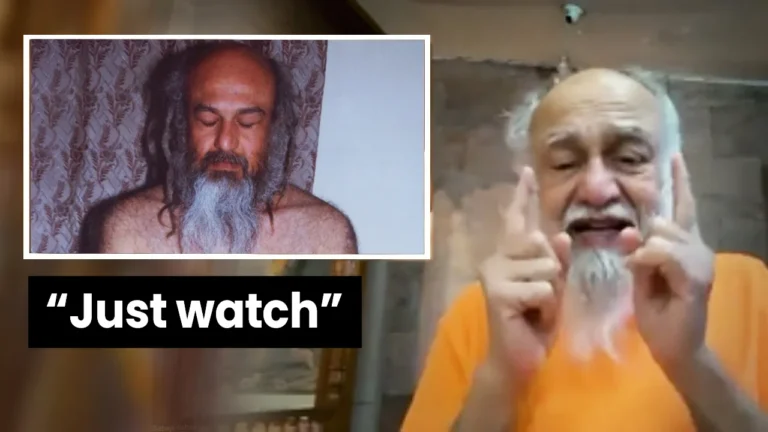
See, now, mind is preoccupied with its imaginations, thoughts and visions. So, when we ask you to watch in between eyebrows, precisely we are asking you to practice to keep quiet mentally. “Just watch” means, that’s it. You are not watching anything. We are not giving you any target. I have never asked you what it is that you have to watch. Simply, I ask you to just watch, but I don’t tell you what it is that you have to watch. There is nothing. Simply, the mind has to watch itself. For that, the mind has to become quiet. It has to withdraw its attention from its own imagination. Then, when the imagination disappears, the attention automatically goes to that infinite purity which we recognise as Pure Consciousness of Existence. That is where the existence idea is coming from and your mind gets absorbed into that. These things will always happen automatically. Your job is to achieve silence of the mind. The rest, amazing experiences, hair-raising experiences, awesome things will come automatically. Your attention goes to that.
Question:
So, Baba, the mind, actually its consciousness, but it’s the potential of consciousness to imagine or to create or to manifest. The difference between consciousness and mind; the way you’re using mind is it’s the nature or potential of consciousness to express itself in some type of creation or imagination, and when that’s there, you call it ‘mind’. When it’s not there and there’s nothing in it, then you call it ‘consciousness’. But that used to drive me crazy when you used to call them the same thing, sorry.
Shri Babaji:
Yes, you see, the Ultimate Truth can be expressed only by remaining silent in itself. Because that is the Truth of Existence, and that has to be the expression, not by any words, not by any language, not by any seen or seer or any such thing. Not by creating anything else. No matter if it creates the most beautiful scenario in the entire universe, entire creation, yet that Ultimate Truth is beyond that beautiful creation also, actually. So that is how the silence is the only way that it can express. Any other type that it tries to express itself, it is limited always.
Question:
So, science will never really be able to fully prove the Self, because the only way to know the Self is to become the Self; is to stop thinking.
Shri Babaji:
Yeah, they have to realise that all attention to the matter needs to come to an end. And also they need to realize mind can give only what it imagines. This truth must dawn upon them, they should understand. When it imagines and gives as a definition, it cannot be the truth. It cannot be the complete truth because it is imagined. That is not the Ultimate Truth. We have imagined as ‘apple’, no problem, if the entire world recognises apple as an ‘apple’ and uses it as an ‘apple’, it’s no problem. But that cannot be the Ultimate Truth, because that we have imagined for sake of our own understanding, our own communication only. We have imagined. Once we have imagined, that is not the truth. That is the limited one. Imagination is always limited, no matter if it can go to the Milky Way and galaxy after galaxy, can go after, after, after go, but it’s always limited. Only the space is unlimited, that which has never been imagined. The space itself also does not imagine anything. That’s why it is Divine in nature.
Question:
So, in science, even if you’re imagining the finest particle, the finest field, it is still an imagination and not the Truth.
Shri Babaji:
That’s why I try to tell, through science we have been able to reach only a nearest cause or an immediate cause, not the root cause. Root cause can never be expressed or defined— impossible.
Question:
Okay, I’ll read. “As long as the mind is bound to this world, desires keep arising, and the mind does not stop as it’s searching for the same Peace it had enjoyed by remaining in the Self by becoming totally, absolutely quiet to make it appear as space, but it is Supreme Consciousness.”
Shri Babaji:
Yeah, these are my words. I know, I keep telling this is the one.
Question:
“Their external ways are no sure clue to their inner illumination.” Now this is you commenting that you can’t tell who’s an enlightened person by looking at them, only another enlightened person can tell if a person’s enlightened or not.
Shri Babaji:
Buddha at gas pump. He might be filling gasoline into your car. He might be a Buddha, who knows, type; something like that. That you cannot recognise. He might appear as an ordinary person just eating like anybody else.
Question:
Well, Baba, that pretty well covers this chapter on ‘Tranquillity’. I realised that ‘tranquility’; maybe if you wrote this scripture, you might have said ‘peace’, because tranquillity and peace are very similar.
Shri Babaji:
I’m not sure, it is the language problem. A certain word, what meaning it can give. For us, we have heard; using a tranquilliser, like a tablet, a pill to tranquillise yourself. So, listening to this, I find a tranquilliser as a temporary relief, which is not a permanent, natural relief that you are giving, whereas peace is a natural relief to the mind that you are practising without harming the health of the brain. Naturally, you are withdrawing the mind and making it Pure Consciousness, then it gets absorbed into the Self. That is natural; that is why peace is the recommended thing. That is my understanding of the language or the terminology of tranquillising.
Question:
Tranquillity, usually I think of is, you know, kind of calm, peaceful, no motion, and that’s what tranquillisers do.
Shri Babaji:
Yes, but it has to come naturally, without anything artificial or any help of any matter, or any tablets or any such things.
New Questioner:
Thank you so much for this morning. Okay, so I have been thinking a great deal of everything you have been teaching me, as I try always to do. In this conversation, there’s a couple of things. You said the mind is preoccupied with its imagination, so that’s one of the two things I wanted to ask you about – the mind is preoccupied with its imagination – that is, to me, very powerful. So, is it that the imprints of the mind, or the imprints within the mind, are really the habits and patterns? Because habits and patterns are very difficult to break. We get into a habit and we don’t even know we’re in a habit. So, are these imprints in the mind the habits and patterns that we have adopted, not only in this life, but through our karmas, and also the karmas of our ancestors? Do we also contain that along with our own? Does that question make sense?
Shri Babaji:
No, you see, any karmas are absorbed by yourself with the idea of a doer-ship. That might be coming from previous lives, but others, like a parent or ancestors, need not be the reason. They might appear to be, but if it is our own weakness that we pick up by watching anybody. As a child, if we get to see our parents closely, more than anybody else, if we are picking up, that means that picking up habit is coming to us from our previous lives.
So that’s what I try to tell, every soul is bringing its own acquired habits, which form the basic nature of a person. Basic nature means here – this point needs to be understood – somebody trying to brainwash you or teach you or give you anything by their own behavior or such things, more than that, when you pick up such habits based on your understanding ability, your observation abilities, thus you are the primary reason to pick up any such karmas, that’s what we have to tell. So now, this world exists in front of you. It is there. What you are going to pick up from this world solely depends on your ability.
Same Questioner:
That makes so much sense, because I sometimes wonder—so we only pick up that which is part of ourselves. That’s why people in families, some siblings, pick up more or different patterns than others.
Shri Babaji:
Yes. I have also told the example, when parents have two or three different children, they will try to look after each equally to their ability, whatever is possible. Yet different children may pick up different attitudes and temperaments, these things, because they are bringing from previous lives. All children need not have the same type of abilities and temperaments and attitudes. That’s what we call as a basic nature of a person.
Same Questioner:
So, we are really very protected from the world and its influences, and we’re only susceptible to what we ourselves have. That makes so much sense. Thank you, Baba. I’ve been thinking about this and thinking about this a lot and wondering how that works. Thank you.
New Questioner:
Pranams Babaji, So, I have a question. Especially for those of us who have grown up in Western culture and our family members may have a totally different understanding or view on spirituality, when somebody important to us inquires about our path, and what the goal may be, how to explain to them what it is we’re trying to achieve? Because in their mind, sometimes it may sound a little bit nihilistic when we say, ultimately, we’re trying to stop the thought process and disappear, really.
Shri Babaji:
You see, you can try to talk based on some important points. Everybody knows they have a mind. We are trying to achieve peace in the mind. I am trying to become a master of my own mind. I don’t want to allow the mind to go like a monkey aimlessly. This is one thing. Also, “I want to bother; when this body was born was I born with this? When this body dies, am I going to become extinct, or am I going to exist in some other form? I am trying to bother about this. This is my path.” Like that you can explain. Everybody belonging to all fields, they feel pride. They take pride in their path. You should take pride in your path. This is important, important about our own Self.
Same Questioner:
Yes, so search for the thread that unites all paths. Thank You, Babaji.
New Questioner:
Baba, I was wondering, is the ability to understand from our karma, from our prarabdha karma?
Shri Babaji:
Yes, that gives the ability to understand. If you clear your mind more from its own thoughts and imagination, it gains better ability to apply brains and understand also. This is also important to understand.
New Questioner:
Pranams Babaji, I have two hopefully quick questions. The first is, I believe You’ve said, in Nirvikalpa Samadhi you observe, or maybe before, you observe matter disappearing. Please correct me if I’m wrong, but does that mean the universe, or all creation, doesn’t exist without you to observe it? In other words, does it need an observer to exist?
Shri Babaji:
Yeah. In Nirvikalpa Samadhi means, just now in your mind, with this potency, you have not created this world; this universe has been created by a higher consciousness. So, through tapas, when you reach that consciousness and achieve Nirvikalpa Samadhi, then you experience that disappearance of the entire creation, when you become totally quiet and merge with the ultimate Truth. That’s what I would have tried to tell.
Question:
Okay, and then, just really quick, the second question is, I find Black Holes fascinating, and you’ve talked about them before. Do you know what’s on the other side of a Black Hole? Is it Supreme Consciousness, sort of sucking matter or dissolving matter?
Shri Babaji:
Ultimately, it is the Supreme Consciousness to which everything will get absorbed. When we use a word, certain terminologies may give a negative feeling, but certain terminologies give a natural feeling. Getting absorbed into the Ultimate Truth is a welcome thing, is a positive thing. But if we talk of a Black Hole, and a Black Hole sucking everything, it appears to be a bit negative, destructive. So many times, people discuss, God, why did He create if He wanted to destroy? It is not destruction. It is withdrawal. Just like you imagine in your mind, when you don’t want to imagine, you become quiet. That means you are withdrawing all the imaginations that you have created in your mind, so you are not doing anything wrong to anybody. You are doing a favour to all those imagined substances that are in the mind, which are unnecessarily miserable because of your own imagination.
New Questioner:
Hi, Babaji. Pranams. You have said in the past that purpose is an artificial invention that we choose. Would you please talk about the right way to select and then cultivate a purpose?
Shri Babaji:
A purpose should be first to know yourself better. Some basic points if you try to think, as I was trying to tell a while ago to Nick, the basic thing is a birth and death is inevitable, of the physical body, everybody knows. Then where do I stand? Who am I? You need to bother about this. That should be the purpose, so that there is a chance. “Is there a chance at all? Am I going to become extinct when the body dies? Am I going to exist in some other form? What the truth is?” Like that you try to set the highest purpose. If you want to achieve anything, if you want to achieve happiness, achieve the supreme permanent happiness which will remain twenty-four hours, twelve months, like that you have to set a highest purpose always.
New Questioner:
Baba, I want to ask you about the role of enjoyment in the life of a Self-Realised Being. I’ve read that Swamiji used to enjoy very much to take a bath in a river. So, if He was driving to get somewhere and there was a river by the side of the road, sometimes He would ask the car to stop and He would go in and take a bath. And I’ve seen videos of Him. He looks like He’s just having such a wonderful time. And then there was Ramakrishna, who would dance around and sing and make fun of his devotees. So, it seems like different Self-Realised beings have a different relationship with enjoyment. Could you talk about this a little bit?
Shri Babaji:
First point, Self-Realised, they don’t indulge any into the worldly activities for their own enjoyment. This is one thing. Number two, if Swamiji got into the water for bathing, it used to give to happiness to others who were around Him, He used to feel that. This is one thing. And there is another important thing. Sometimes, Self-Realised Souls indulge in such things to keep themselves awake in this world, alive in this world, so that they can continue helping create awareness about the Self. Like Ramakrishna Paramahamsa, as you are talking, once He was talking to His students, disciples and from the kitchen a beautiful smell came of cooking. He suddenly got up and started talking, “How beautiful smelling this cooking is!” He started going towards the kitchen. His wife, Sharadamani Devi, was bewildered. She said, “What will your students think Thakur, if you behave like this, just for eating and taste you are coming out of the room while you are talking to the thing.” Then Ramakrishna, smilingly, said, “Let me do this. I can keep this body for some more time, and I can give my teachings to them, and then this body will come to an end.” So, like this, also, Self-Realised Souls behave, for sake of others. To create this awareness they can continue with the body for some more time. Many different Self-Realised Souls keep different types of activities like that.
New Questioner:
I do mantra japa. I don’t do it one hundred and eight times sitting at one place. Randomly I do. So, is sitting at one place to chant better than just doing it any time? Is it more effective?
Shri Babaji:
Sitting at one place, you practice so that your mind remains focused on to the mantra jap. Then once you become expertised, then you can keep moving and also chant. There is no harm in it. Chanting the name of God is better, like that also. But first you sit down at one place and practice so that your mind becomes focused on to the mantra, that is important.
New Questioner:
Namaste Babaji, if someone has negative imprints of somebody, how to get rid of those negative imprints?
Shri Babaji:
Remember God. Remember the name of God always, and meditate. Only then your consciousness will become clear of such negative things, and you will have the Supreme Peace. God will help you to overcome these things. Have faith in God and Guru and chant their names – that will help you.
Same Questioner:
I have recovered so much from my past experiences. I’m better now, but the surroundings and the environment, it affects. That’s why sometimes it’s happening.
Shri Babaji:
It is very good, and you continue with the name of the Guru and God, and it will definitely help you to overcome completely. You will be alright. God bless you.
Facilitator:
Baba. There are a few questions in the chat. Do we have time?
Shri Babaji:
Okay, we will take as the last thing.
Question:
The attributes that mind can experience of space are silence and peace, conceivable by its imagination. Are peace and silence the only worldly imaginations of space, the Self or are there others that can be experienced, dodging the brain—like tranquillity?
Shri Babaji:
When your mind becomes quiet, you will see that mind as the form like space, infinite, and then it merges with the Supreme Space. Just for the sake of understanding, I’m telling. So, then you experience in Nirvikalpa Samadhi that space as the Supreme Consciousness of Existence, which is beyond all imaginations. It is not an imagined thing, but an experience. Experience is different. Imagining about a thing is totally different.
Question:
Another question, how to know whether a thought is arising from intuition or imagination?
Shri Babaji:
Any intuition also is born out of imagination only. When such a thing happens, you try to call it as intuition. If such a thing doesn’t happen, you try to call it as imagination. It’s a coincidence. Intuition is totally different. When an imagination arises, many people try to claim—”It used to come and the same thing used to happen in my life”. They are all coincidences, that is all, what spirituality talks about it. What is needed is that you practice meditation and quieten your mind to know the truth of your own existence. That is the foremost important thing.
Question:
Last question, Baba.
Can unhappiness return for enlightened ones, and can an enlightened mind be free from states of body, like health, illness, pleasure, pain? Can it retain happiness irrespective of the body?
Shri Babaji:
Unhappiness never comes back to an enlightened soul, and his consciousness will always be on the Self. Because a little bit of consciousness is in touch with the brain to keep the body alive, a yogi also can feel the pain, this is possible. But he will not suffer mentally. Suffering mentally and feeling the pain are two different things. You feeling the pain and suffering it in the mind are totally different things. That suffering will not happen for a yogi, an enlightened soul.
Facilitator:
Thank you, Baba, that’s it for today.
End of Session