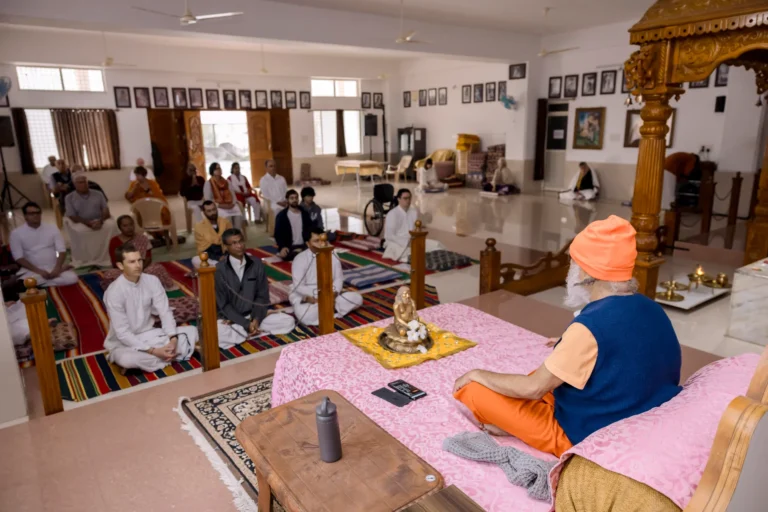
Recorded on 26 April 2026 with US participants
0:00 Intro
1:12 Chapter 18, verse 10
2:05 We have come up with words to describe things which are imaginations that are different from different people, and ultimately unreal?
7:43 Verse 11
8:03 Yogis have no dualities – always contented in the supreme peace of Self awareness.
9:01 We are so used to thinking of acquiring peace as something in our mind instead of going beyond it all.
9:30 How does the mind lose its way and forget itself?
10:34 Verse 12
11:01 A Yogi has transcended all worldly pleasures. They have achieved that, after which there is no need to achieve anything else.
13:47 It is getting over the ego, “I am this, I am that.”
14:26 Verse 13. “A Yogi has neither any worldly duties to perform or any attachments to anything.”
16:14 Do the answers to questions come to Babaji spontaneously?
16:43 Does a Yogi have imaginations flowing though the mind?
18:19 So a Yogi has no worldly duties to perform?
20:32 A Yogi’s mechanical body actions are the effects of their past karma.
23:24 What did Babaji mean by ‘the body is just a robot’?
24:16 Babaji is not a person?
25:30 If a Yogi comes across suffering of others or if someone prays for them to help, they will always be compassionate.
26:38 Is it important to ask the Divinity for something you want?
27:13 Verse 14. “Where Is liberation for the great one who rests now beyond the world of desires?”
29:16 Verse 15. “Although bodily they see the world, a Yogi actually, in consciousness, does not see anything.”
31:52 If you are not liberated and you hurt yourself, it’s hard to tell them that it doesn’t hurt.
33:02 Does Yogi just witness the pain but is not involved?
33:34 Verse 16. “In meditation the mind directly gives up all imaginations simply by watching itself. A practice to realise the Self as it is without any attributes and to rest consciously in the Self.”
36:18 Verse 17.
37:01 What does it mean that a Yogi has no distractions?
38:59 Is it possible for a person to lose their identity as a result of extensive meditation?
40:35 Are there two identities, one of the person which is held in the brain, and then one of being the Yogi?
41:22 What does Babaji mean by, “You cannot make yourself disappear.”
42:10 For a Yogi, the consciousness of existence has to be functioning in order to have that “I”?
42:41 So there is a person, body and mind, then a witness to what we are seeing and hearing, and then there is the consciousness of existence and then that merges back into pure consciousness?
43:29 What causes eternal existence to become conscious of its existence?
45:21 When you see situations that bring a lot of suffering, how to keep away from judgement and wanting to change the situation?
48:51 God appears to people the way that they perceive.
50:23 Can one meditate when one is travelling?
51:02 Does hunger arise in the Yogi’s body?
52:08 How to stay grounded as the meditation practice progresses?
53:29 What to do when there is anxiety in the body?
55:30 Why can we not imagine the images of the Deities after returning from visiting the temple?
56:58 Inability to progress in vipassana meditation
58:16 How long should I practice meditation?
58:33 Do divinely inspired ideas come into the mind, or is that simply the imagination?
59:38 What is the difference between the consciousness of existence and the pure consciousness?
1:00:50 Is pure consciousness the absolute?
1:01:06 Does consciousness become mind or does mind become consciousness or do they come simultaneously?
1:01:49 When the consciousness of existence arises from the absolute, it has the inherent ability to imagine?
1:02:44 Brahma is the ‘I am-ness’ without anything else?